
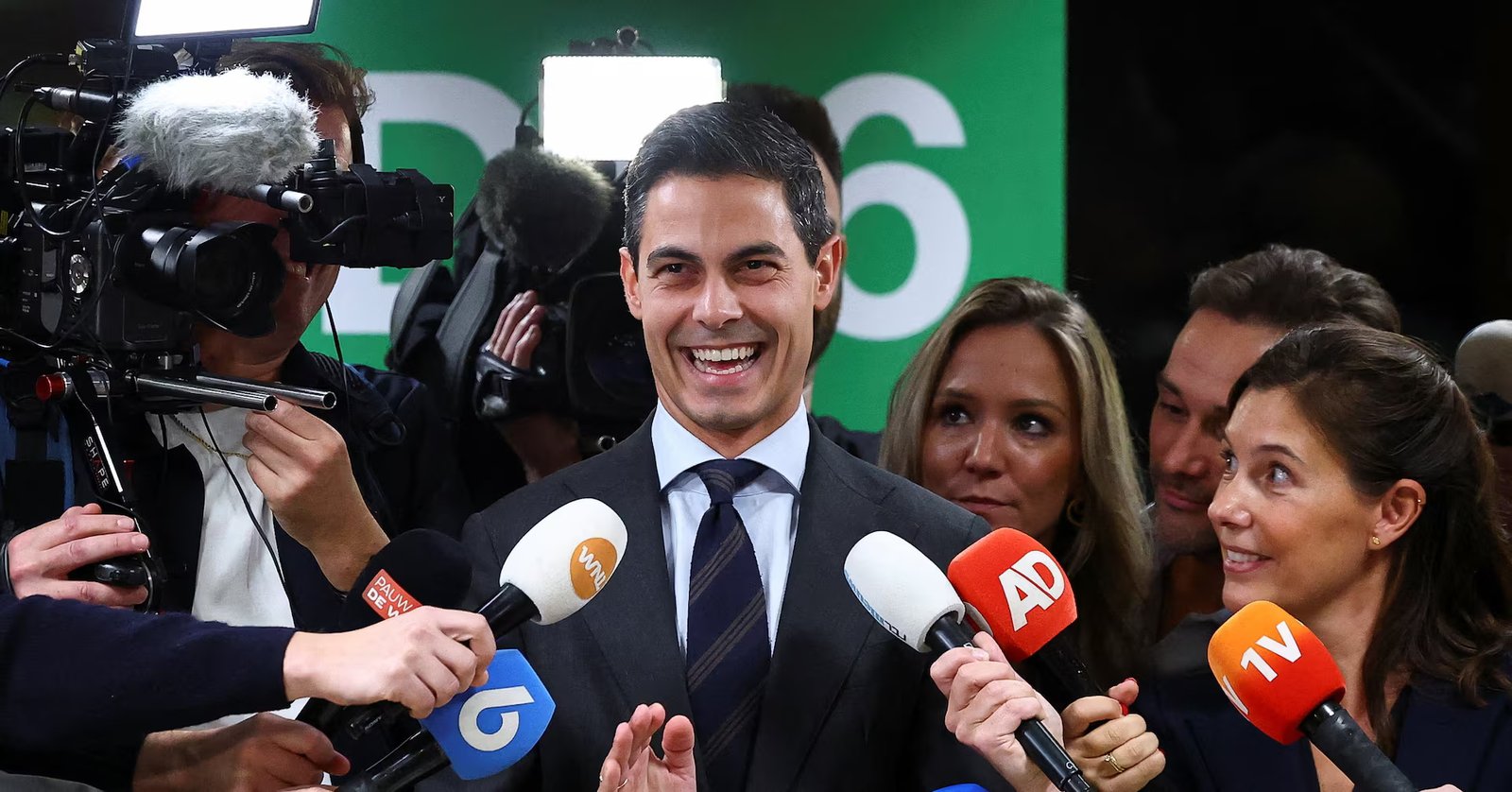
With most of the votes counted, Jetten’s D66 and Wilders’ PVV were neck-and-neck on Thursday, with both projected to take 26 seats in the 150-seat lower house of parliament.
Sign up here.
That was a sharp drop for Wilders’ party, which lost over a quarter of its seats in two years, stemming from a poor performance in its first attempt at government and growing competition on the right.
WHAT COMES NEXT? WAIT FOR TUESDAY
The D66 party tripled its seat count with an upbeat campaign, polished messaging and a surge in advertising spending.
The result was a “very strong message from Dutch voters that they want positive political powers in the center to work together,” Jetten told reporters.
With 98.9% of the votes counted, D66 led PVV by 15,000 votes, Dutch press agency ANP said. Although both would have the same number of seats, the centrist party’s lead, if confirmed by the final tally, means parliament would likely task it to form a government.
Item 1 of 5 Democrats 66 (D66) party leader Rob Jetten reacts next to the media members at the Dutch Parliament, after the Dutch parliamentary elections, in The Hague, Netherlands, October 30, 2025. REUTERS/Piroschka Van De Wouw
As the counting of the votes will likely continue until the start of next week, party leaders will only convene next Tuesday to discuss what comes next, a parliament spokesperson said.
JETTEN ‘VERY CONFIDENT’ ON COALITION
At 38, Jetten would be the Netherlands’ youngest, and first openly gay, prime minister, if he can successfully complete coalition talks. This process, which usually takes months, is likely to be particularly complex in a very fragmented parliament.
During the campaign Jetten moved beyond his party’s traditional themes of climate change and education, plunging into the divisive topics of immigration and a housing crisis. In the process he won over some voters who had previously looked to right-wing parties.
“I’m very excited that we’re going to have the first homosexual prime minister in the Netherlands and also one that is combining all the positive forces,” Lotte van Slooten, a 25-year-old voter, said at a D66 election rally.
TEST OF FAR-RIGHT STRENGTH IN EUROPE
The election was seen as a test of whether the far right can expand its reach or whether it has peaked in parts of Europe, and the outcome suggests there are some limits to its appeal.
Simon Otjes, assistant professor in Dutch politics at Leiden University, said the far right would continue to be strong. “They’ll dominate the public discourse,” he said.
However, with D66 being a very pro-European party “we can expect a more active role for the Netherlands in Europe,” Otjes said.
Reporting by Stephanie van den Berg, Bart Meijer, Marta Fiorin, Milan Berckmans; Additional reporting by Toby Sterling, Suban Abdulla; Writing by Ingrid Melander, Charlotte Van Campenhout; Editing by Timothy Heritage and Toby Chopra
Our Standards: The Thomson Reuters Trust Principles.