
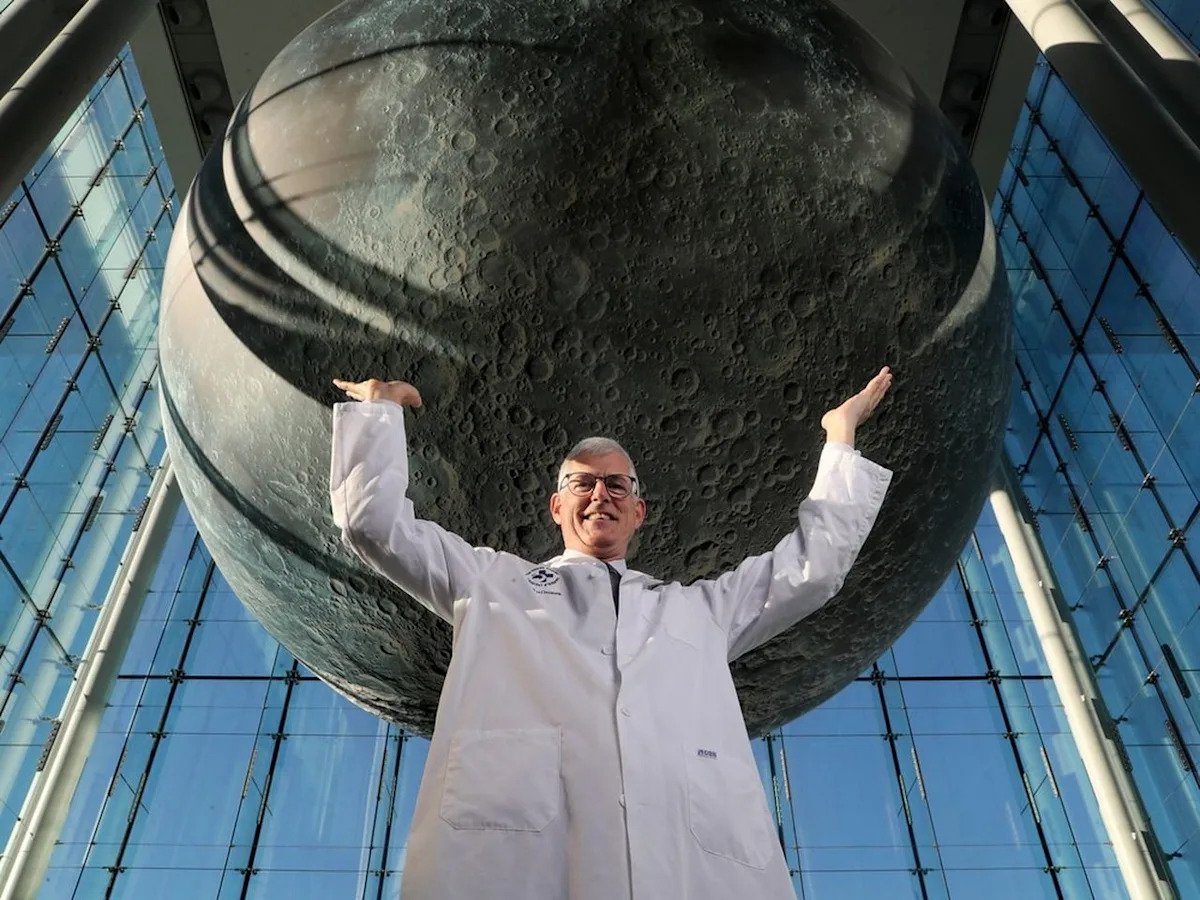
Dr. Guy Trudel often tells his rehab patients that the work they are doing to regain mobility and function is similar to what astronauts do when they return from space.
In fact, people on long-term bed rest experience similar challenges as astronauts at the International Space Station, where microgravity results in less muscle use.
Astronauts commonly suffer from a number of health issues, some serious, when they return to Earth after long periods in space, ranging from loss of bone density and muscle to eye problems and anemia. It can take months of rehabilitation for them to regain full function.
That is something Trudel frequently talks to his patients about.
“I often refer to how the rehabilitation of astronauts goes and I tell my patients, ‘You are doing the same thing as if you are returning from space,” Trudel says. He also draws the parallel between astronauts and rehab patients as part of teaching medical residents.
It is a subject that Trudel, a rehab physician and researcher at The Ottawa Hospital and a University of Ottawa professor, knows well.
For years, he has studied a phenomenon known as space anemia, the loss of massive amounts of red blood cells by astronauts when they are in space. The latest research led by Trudel, which focuses on astronauts’ spleens related to loss of red blood cells in space, is one of four new Canadian studies that are being conducted aboard the International Space Station.

Dr. Guy Trudel, a rehab physician and researcher at The Ottawa Hospital and a University of Ottawa professor, has studied the phenomenon known as space anemia for years.
Details of his latest experiment, known as Spleen Activity in Space Anemia (SPA2), were among space studies revealed in late October by the Canadian Space Agency.
The spleen is an organ that plays an important role regarding red blood cells, acting as a filter that removes old, damaged or malformed red blood cells.
The experiment will measure changes in astronauts’ spleen size while they’re in space as well as the destruction of red blood cells in astronauts before, during and after their space mission.
Trudel’s work is aimed at better understanding what causes space anemia and how to alleviate symptoms, something that will be crucial as humanity prepares for longer duration space missions to the moon and, eventually, Mars.
The research is also contributing to a better understanding of some of the parallel issues faced by patients on Earth, including those trying to recover from long bouts of inactivity after accidents, serious illnesses or other reasons. Around 95 per cent of rehab patients become anemic, Trudel says. In long-term care facilities, 48-63 per cent of residents experience anemia. Knowing how to manage or prevent it, and better understanding it, could improve their recovery and their lives.
“Learning more about anemia in space could lead to solutions for a large population of patients on Earth,” Trudel says.
Currently, astronauts at the International Space Station remain in space for between six and eight months. Joshua Kutryk will be the next Canadian to go to the station, although a date has yet to be set.

Canadian astronaut Joshua Kutryk expects to be in space for between six and eight months and he will then be unable to drive for six months after he returns to Earth because of eye and other issues related to the physical affects of living in microgravity for an extended period of time.
In late October, Kutryk joined Trudel and other researchers to talk about the new Canadian space research and the value of scientific research done in space. Kutryk says it is uncertain whether his time in space will coincide with the new Canadian research projects that are just some of the numerous research projects on the space station.
Still, Kutryk says it is notable that so much Canadian science goes into space.
“I’m proud of the fact that we are doing this in Canada. It’s not a given,” he says. “There are many, many countries that are like Canada in other ways, but they are not contributing to human spaceflight. They are not doing science in outer space that is making life better for people here on Earth. That is something that Canada has always done, and we do it very well.”
Kutryk expects to be in space for between six and eight months and he will then be unable to drive for six months after he returns to Earth because of eye and other issues related to the physical affects of living in microgravity for an extended period of time.
In previous studies, Trudel and his team found that astronauts lost an average of three million red blood cells every second they were in space. A subsequent study found that astronauts recovered the enormous amount of red blood cells they lost in space within 41 days of being back on Earth.
Trudel says there are still many questions to be answered about why astronauts develop anemia and some of those answers might also help better explain high rates of anemia in people on Earth who are inactive for a variety of reasons.
Our website is your destination for up-to-the-minute news, so make sure to bookmark our homepage and sign up for our newsletters so we can keep you informed.