
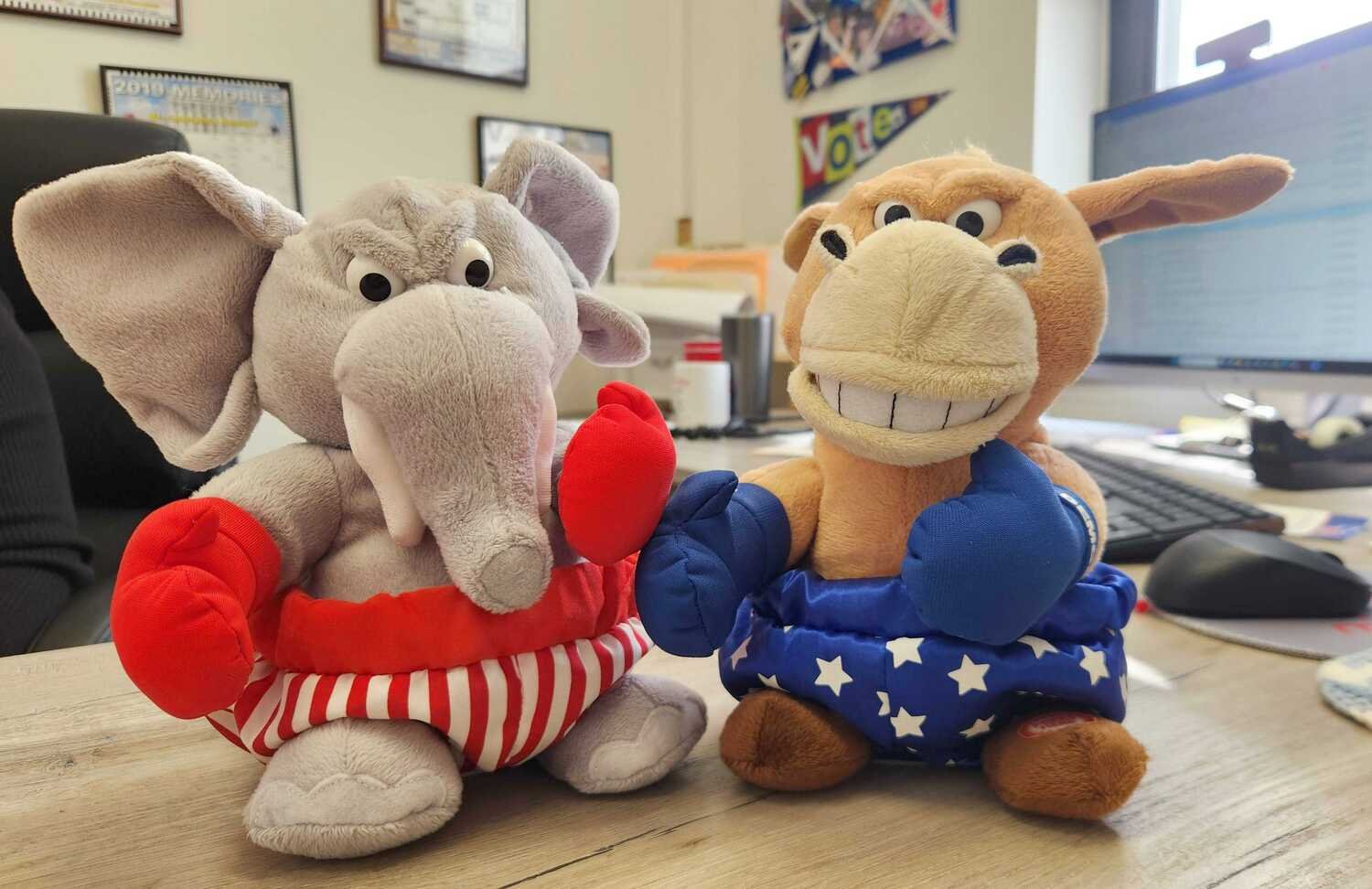

The general election is Tuesday, Nov. 4. Early voting started last Saturday, Oct. 25.
While this is a quiet election year on the state and national level, there’s been significant competition in some local races that’s brought fresh faces to politics.
Reporter Amy Feiereisel spoke with Catherine Wheeler about what’s behind the new names on the ballots in some of the region’s high-profile elections.
……………………
CATHERINE WHEELER: So first off, let’s talk about this 2025 election. It’s obviously a much ‘quieter’ one; there’s no presidential race, a shorter ballot and a focus on local races.
AMY FEIEREISEL: Exactly. Think mayors, town supervisors, town councils, highway superintendents. And typically, in “off-year elections” you see much lower voter turnout. But the reason I’m here today is to talk about how even in this sort of sleepy year, there’s some real competition in a few key races, and some political newcomers.
WHEELER: And that’s a real shift from what we saw last year. Locally, there were so many uncontested races.
FEIEREISEL: Exactly! And to be fair, we’ve still got plenty of those this year. It’s not like there’s buckets of new enthusiasm for local politics. But one race where there was no shortage of people throwing their hats in the ring was in Watertown, for two seats on the City Council. Nine people ran in the primary for those two seats.
WHEELER: That’s a lot of candidates – how unusual is that here in the North Country?
FEIEREISEL: Yeah, I thought this was very notable, but to confirm that, I got in touch with the Jefferson County Board of Elections. I talked to Republican Commissioner Tiffany Ladd and Democrat Commissioner Michelle LaFave, who speaks for most of this upcoming clip. I basically asked them if this many candidates for two council seats was out of the norm.
TIFFANY LADD and MICHELLE LAFAVE: “Yes! The city elections over the past 3-4 elections, they’ve generated a lot more interest. There’s a lot of people that aren’t necessarily happy with how the city is being run and the decisions that are being made out of council. I think because of everything going on in the city, there’s people that want to make a difference.”
What she’s talking about is the negative public perception of the council, which was a big topic in the primary debate. Candidates talked about in-fighting during public meetings, a criminal probe into the council’s vote to buy a golf course, a personal ethics complaint. Here’s candidate Pete Monaco during that debate.
PETE MONACO: “It’s kind of sad when you hear your neighbors say, ‘Oh, I got to get home’ to [watch] the council meeting on Monday night. It’s cheaper than a movie.’ It’s just been a not good image for the city for the last, say, five years.”

The candidates also had broader concerns about the city facing big budget deficits, the end of a lucrative National Grid contract, and rising homelessness. Many said they were running because they want to see a council that is productive, and not controversial, and in hopes of more united city leadership.
WHEELER: Okay, so how did the primary play out? There were nine candidates, only four would move on to the general election, to then compete for the two seats. Who made it through?
FEIEREISEL: Yeah, so here’s the other interesting part of this race. There were two incumbents who wanted to be reelected: Lisa Ruggerio and Cliff Olney. And usually, incumbents have a big advantage. But neither of the incumbents won in the primary. And the four candidates who did – Doug Osborne, Shane Garrabrant, Pete Monaco, and Anthony Velazquez – are basically political newcomers, having not held elected office in the past.
WHEELER: So the voters basically chose new blood over people who had already been in office.
FEIEREISEL: It certainly seems that way. And that ‘new blood’ theme is one that carried through most of the contested races I looked at.
WHEELER: Yeah, let’s turn now to the Glens Falls mayoral race. Democrat Bill Collins has led the city for the last four years, but lost the primary to Diana Palmer. She’s not a political newcomer, she’s served on the city council for the last eight years, but it’s notable that she won the primary by such a wide margin.
FEIEREISEL: Palmer won in a landslide, with more than 70% of the vote. This is particularly interesting because Collins’ first term as mayor was not rocked by scandal or by financial woes, and Collins and Palmer are both Democrats. So why did Palmer win? Her supporters say they appreciated her community outreach and they called her a QUOTE, “fresh face in city politics” who was outside the local “good ole boys club.” Here’s Palmer speaking to WAMC on election night back in June.
DIANA PALMER: “Voters of Glens Falls really want a government that will listen to them, collaborate with them, be responsible with their money, and make informed, careful decisions.”

Bill Collins had still planned to run in the general election as a third-party candidate, but announced on Oct. 20 he was exiting the race, basically saying he wanted to avoid further dividing Glens Falls.
WHEELER: So again, in that race voters chose the new candidate over the incumbent.
FEIEREISEL: The last race I want to talk about is the special election for the 115th District Assembly Seat in the New York State legislature.
WHEELER: That’s the seat Democrat Billy Jones held from 2016 until recently, when he resigned and set off a special election.
FEIEREISEL: Yes, and because it’s a special election, there was no primary. Local county party chairs chose the candidates. For the Democrats, that seemed to be a pretty simple process. They chose Michael Cashman, the current town supervisor of Plattsburgh.
Choosing the Republican candidate was a bit more fraught. To sum it up, NY-21’s Elise Stefanik sort of “surprise” endorsed a candidate. The issue with that was it’s not up to her, it was up to the Clinton, Franklin, and Essex county Republican chairs, and they were still in the process.
WHEELER: And that led to quite a bit of infighting within the party.
FEIEREISEL: Yeah, and it got a bit heated! What I found interesting for this race was who the candidates were. The person Stefanik endorsed and allegedly pressured county chairs to choose was current Malone Village Mayor Andrea Dumas. She’s been in local politics for years. She was a Malone village trustee, she’s a Franklin County Legislator, and she’s been mayor of Malone for six years.
So that’s who Stefanik wanted. But ultimately, county leaders chose Brent Davison, the now-retired New York State Police Troop B Commander. He also served in the U.S. Army, and is a former corrections officer. And while he’s obviously no stranger to leadership, if he wins, this would be his first elected position.
So again, you’re seeing a ‘newcomer’ being chosen over an established political figure. Obviously, each race we’ve been talking about is different, but there is this subtle throughline.
WHEELER: Well thanks so much for breaking down some of our region’s bigger and more competitive races, Amy.