
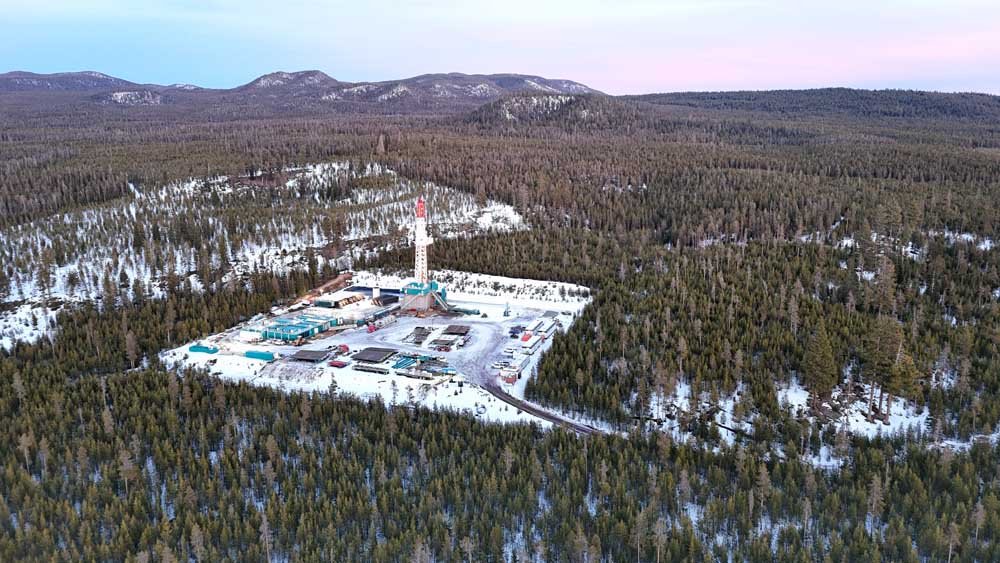
Carbon-free energy production, generated on a small footprint right here in Central Oregon, is one step closer to reality.
Mazama Energy Inc. — a Texas-based company developing next-generation geothermal energy on the slopes of Newberry Crater, south of Bend — said its recent tests at the site have proven successful, and temperatures of 629 degrees Fahrenheit (331 degrees Celsius) have been recorded. The recorded temperatures are all-time highs for this technology.
Mazama adds that its geothermal system has fluid circulating between two wells, a crucial step that will allow steam to rise from one of the wells to the surface to power turbines and generate electricity.
This marks the first time an engineered geothermal reservoir has demonstrated both extreme heat and sustained well connectivity, according to Pete Lumley, Mazama Energy’s communications director.
With the project advancing and proving its viability, backers say they are getting closer to building a power plant near Newberry Crater that could become one of the largest in Central Oregon.
Replacing coal
Tapping into superhot rocks deep below the surface could help Oregon reduce its reliance on distant coal-fired plants. As it stands now, around 28% of the electricity sourced by Pacific Power comes from coal.
In addition to providing the region with carbon-free energy, the development of enhanced geothermal systems in Central Oregon could attract technology companies looking to expand data centers as the AI revolution accelerates. Meta and Apple already operate data centers in the region.
“The Newberry pilot provides a blueprint for unlocking baseload, utility-scale, carbon-free energy from the Earth’s crust worldwide, which is what the next generation of AI and cloud infrastructure requires,” said Sriram Vasantharajan, Mazama’s chief executive officer.
AI and data centers aren’t the only forces driving energy demand in Oregon. Population growth, the rising number of electric vehicles and the shift toward home electrification as residents move away from natural gas are also contributing factors.
Economic benefits
Deschutes County Commissioner Phil Chang said Mazama’s project could help address Oregon’s limited energy capacity while using less land than other renewable options, such as wind and solar farms.
“From a land consumption perspective, these enhanced geothermal systems are really environmentally advantageous,” Chang said.
The project could also have regional economic benefits, said Jon Stark, chief economic officer for Economic Development for Central Oregon, a nonprofit that supports local businesses. He says as energy demand rises in the area, the ability to generate clean, reliable baseload power will help Central Oregon attract new businesses.
“This opportunity will also foster job creation and stimulate investment within the community, strengthening our local economy and enhancing the quality of life for residents,” Stark said.
A buyer emerges
Jim Anderson, chief executive officer for Mid-State Electric, is bullish on the idea of purchasing power from the Newberry EGS project when it becomes available.
“We actually think it’s a game changer,” Anderson said. “I think that it’s going to position our region as a leader in carbon-free power, dispatchable power.”
Mid-State currently purchases most of its power from the Bonneville Power Administration. Anderson said the remainder of its power portfolio could eventually be replaced with power from Newberry.
“Reliable generation is becoming increasingly critical to the grid as the needs are increasing,” he said. “As we look for these sustainable solutions, this project is going to be the perfect type of resource that we need to support Mid-State’s future the rest of the region’s future.”
Project technology
The technology used by Mazama is described as “enhanced geothermal energy,” which involves creating underground fissures in the rock deep below the surface and then injecting cool water into the ground, where it heats up to produce steam that can power turbines.
The project at Newberry is considered an “enhanced” geothermal system because, unlike traditional geothermal projects, this one does not already have groundwater available to extract — the water must be pumped in from a separate well.
The project site, located outside the boundaries of Newberry National Volcanic Monument, sits on the slopes of an active shield volcano that last erupted in 690 AD.
If built, the project will pump water from local wells near the site. The water will be pumped out once and placed into the reservoir, then used over and over again.
When the system is in production, a relatively small amount of loss will occur because of leakage and evaporation. Project coordinators say the amount of water needed for the project is equivalent to one day’s use by the city of Bend — about 20 million gallons.
Proof of concept
Over the past 12 months, Mazama has shifted from planning and testing to demonstrating that the technology works. Engineers completed and stimulated an existing well to serve as an injector, then drilled a new 10,200-foot production well.
“This confirms execution and proof of concept and outlines when and how power generation will happen here,” Lumley said.
The company has set its sights on developing a 15-megawatt pilot power station in 2026, followed by a 200-megawatt project at the site. Officials believe over time the power production could be much higher — up to 2,500 megawatts.
Mazama, a startup with financial backing from venture capitalist Vinod Khosla, says its technology “sets a new global benchmark” for geothermal development.
The effort to generate power at Newberry Crater dates back decades. Much of the earlier work was led by Seattle-based AltaRock Energy Inc., which focused on testing an enhanced geothermal system in partnership with the U.S. Department of Energy, universities and national laboratories.
Two years ago, Texas-based Blade Energy Partners Ltd. and AltaRock Energy formed Mazama Energy Inc. to scale up the Newberry project.